Chapter 5 · All chapters
- 1Decide what problem you are solving
- 2Choose a distribution model
- 3Set up the organization
- 4Plan the space and equipment
- 5Find reliable food sources
- 6Food safety and inventory
- 7Design the guest experience
- 8Recruit and manage volunteers
- 9Board governance and leadership
- 10Money, policies, and accountability
- 11Get the word out
- 12Run a distribution day
- 13Measure results and grow
- 14A 90-day launch plan
- AReady-to-adapt templates
Chapter 5 of 14
Find reliable food sources
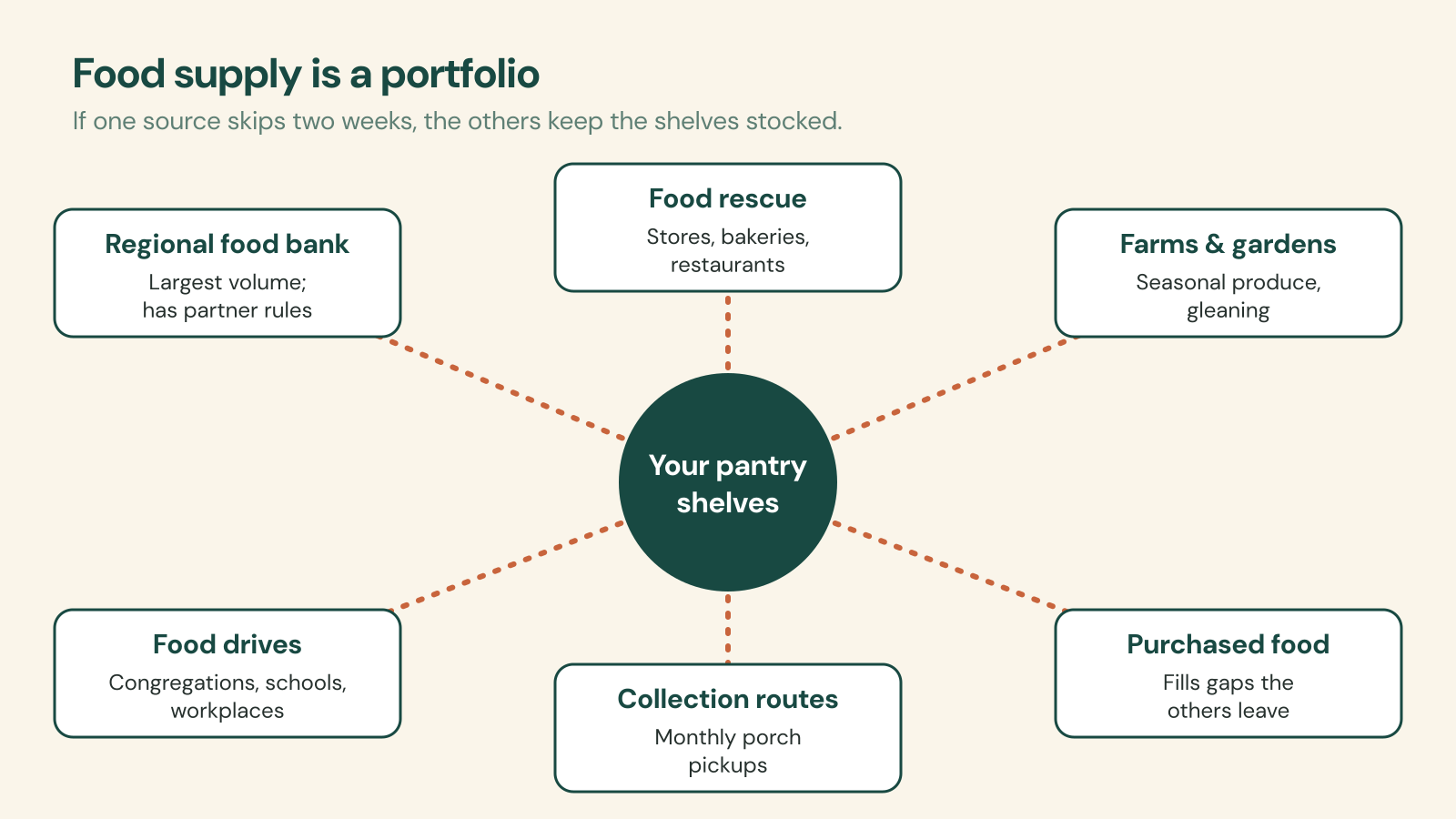
Food supply is usually a portfolio of relationships, not a single vendor. Build reliability before volume.
Your regional food bank
For most pantries the regional food bank is the largest and cheapest source of food. Ask about agency eligibility, waiting lists, delivery or pickup minimums, training, fees, and reporting. Some networks cannot accept new partners right away.
What food banks usually ask of partners
- Proof of 501(c)(3) status, or that you operate under a church or other qualifying organization
- A site visit, with food stored off the floor, pest control, and working thermometers
- Food-safety training for at least one lead
- Regular, published distribution hours and a minimum number of households served
- Monthly reports on households and people served
- Food given free of charge, with no requirement to attend a service or make a donation
Federal commodity food (TEFAP)
Much of what food banks distribute comes from The Emergency Food Assistance Program, and it carries its own rules. Expect to collect a signed household self-declaration of eligibility, give annual civil rights training to the volunteers who work with guests, display the required nondiscrimination poster, and keep distribution records. Federal rules do not require households to bring proof of income, though states set their own details. Your food bank will train you on your state's version.
If the answer is no, or not yet
A "no" is often about one specific requirement. Ask which one, and whether any of these are open to you: joining the waiting list, hosting the food bank's own mobile distribution at your site, receiving food through an existing partner agency nearby, or reapplying once you have a few months of service records. Meanwhile, build the rest of the portfolio.
Food rescue and retail partners
Approach supermarkets, independent grocers, bakeries, produce vendors, farms, wholesalers, and restaurants. Ask for a specific recurring donation or pickup window, not an open-ended promise. Large chains often route donations through the regional food bank or a corporate program, so ask the store manager how theirs works. Appendix H has three email templates you can adapt.
Farms and gardens
Farmers markets, community gardens, and backyard growers can supply fresh produce in season. Agree in advance on drop-off times, and only accept what you can distribute within a few days.
Congregation and neighborhood drives
Publish a short needs list based on what guests ask for. Monetary donations are often more flexible than mixed canned goods; explain both options and let donors choose.
Neighborhood collection routes
A monthly collection route can turn occasional gifts into a predictable supply. Invite households on a defined route to set out a bag of approved, nonperishable donations on a regular pickup day, such as the first Saturday of each month. A neighborhood coordinator collects the bags from porches and leaves an empty bag tagged with the next pickup date. Families can give without attending a separate food drive.
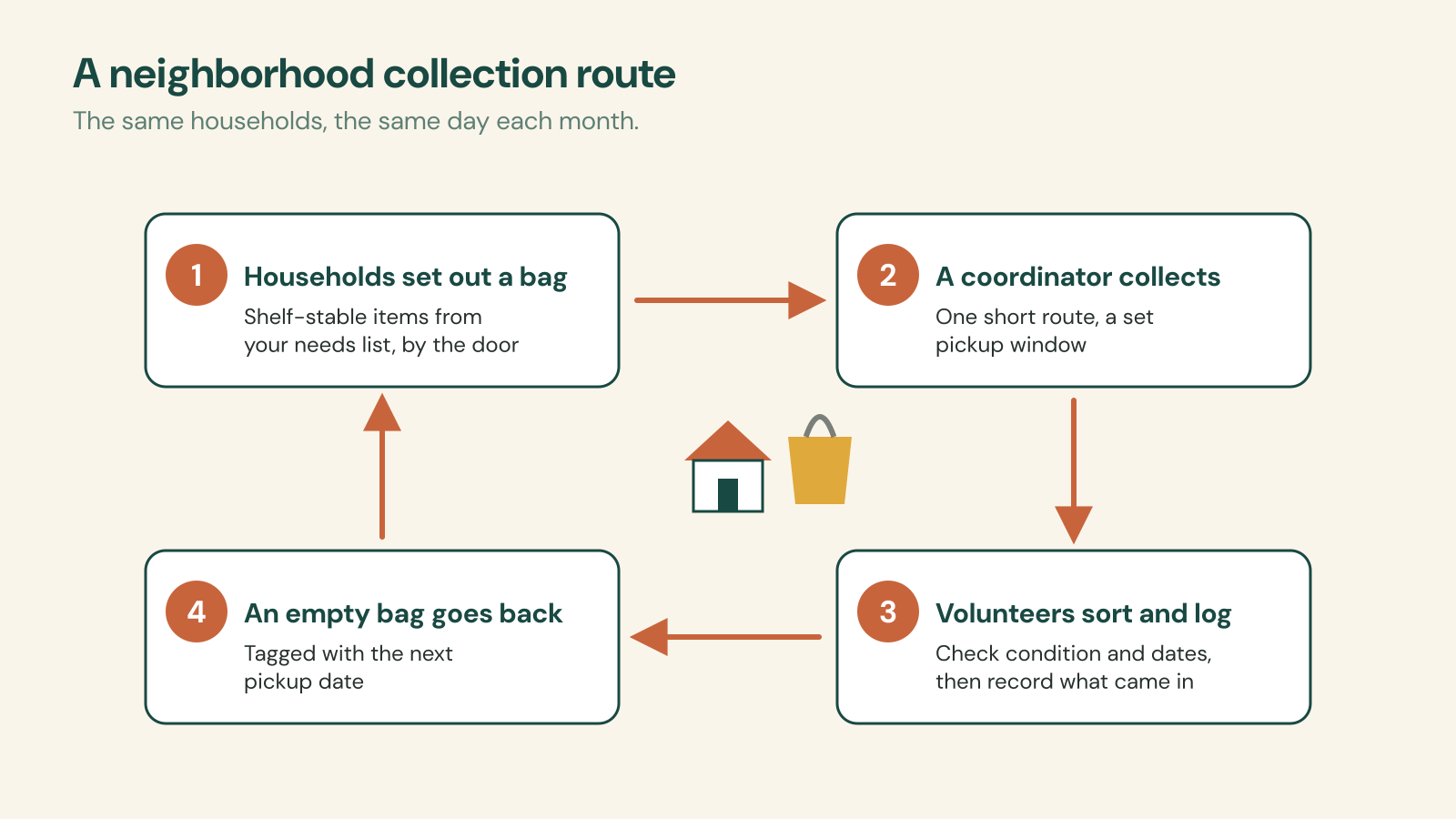
To launch a route, choose a manageable neighborhood, recruit a dependable coordinator and a backup, publish a simple list of needed items, and tell donors when and where to leave their bags. Ask households to keep food protected from rain, heat, animals, and pests. Set a clear pickup window and plan safe transportation, sorting, and receiving. Do not collect refrigerated or frozen donations unless the pantry has a reliable way to keep them cold. Begin with one route, track participation and food collected, and expand only when pickups are reliable.
Purchasing wisely
Prioritize foods that make usable meals. Compare cost per serving, storage life, nutrition, cultural fit, and whether households have cooking equipment. Do not assume bulk packaging is always appropriate. Several small pantries ordering together can often reach a price break none could reach alone.
Beyond food
Diapers, period products, soap, toothpaste, toilet paper, and pet food are among the most requested items at many pantries, and SNAP benefits cannot be used to buy them. They are also shelf-stable and easy for donors to give. Decide whether you will stock them and add them to your needs list.
Document each relationship
Record the contact, agreed pickup times, acceptable products, who provides containers, rejection rules, and emergency contacts. Confirm whether a donor requires reporting or proof of nonprofit status. Track outreach as you go: the store, contact name, date contacted, response, and date of the next follow-up.
Discuss with your team
- What happens if the primary donor skips two weeks?
- Can we accept refrigerated donations safely?
- Which three items do guests ask for that we never seem to have?
Action checklist
Starting points for finding partners
- Feeding America food bank finder
- USDA information on TEFAP
- Food Rescue US
- AmpleHarvest.org, which connects home and community gardeners with nearby pantries