Chapter 2 · All chapters
- 1Decide what problem you are solving
- 2Choose a distribution model
- 3Set up the organization
- 4Plan the space and equipment
- 5Find reliable food sources
- 6Food safety and inventory
- 7Design the guest experience
- 8Recruit and manage volunteers
- 9Board governance and leadership
- 10Money, policies, and accountability
- 11Get the word out
- 12Run a distribution day
- 13Measure results and grow
- 14A 90-day launch plan
- AReady-to-adapt templates
Chapter 2 of 14
Choose a distribution model
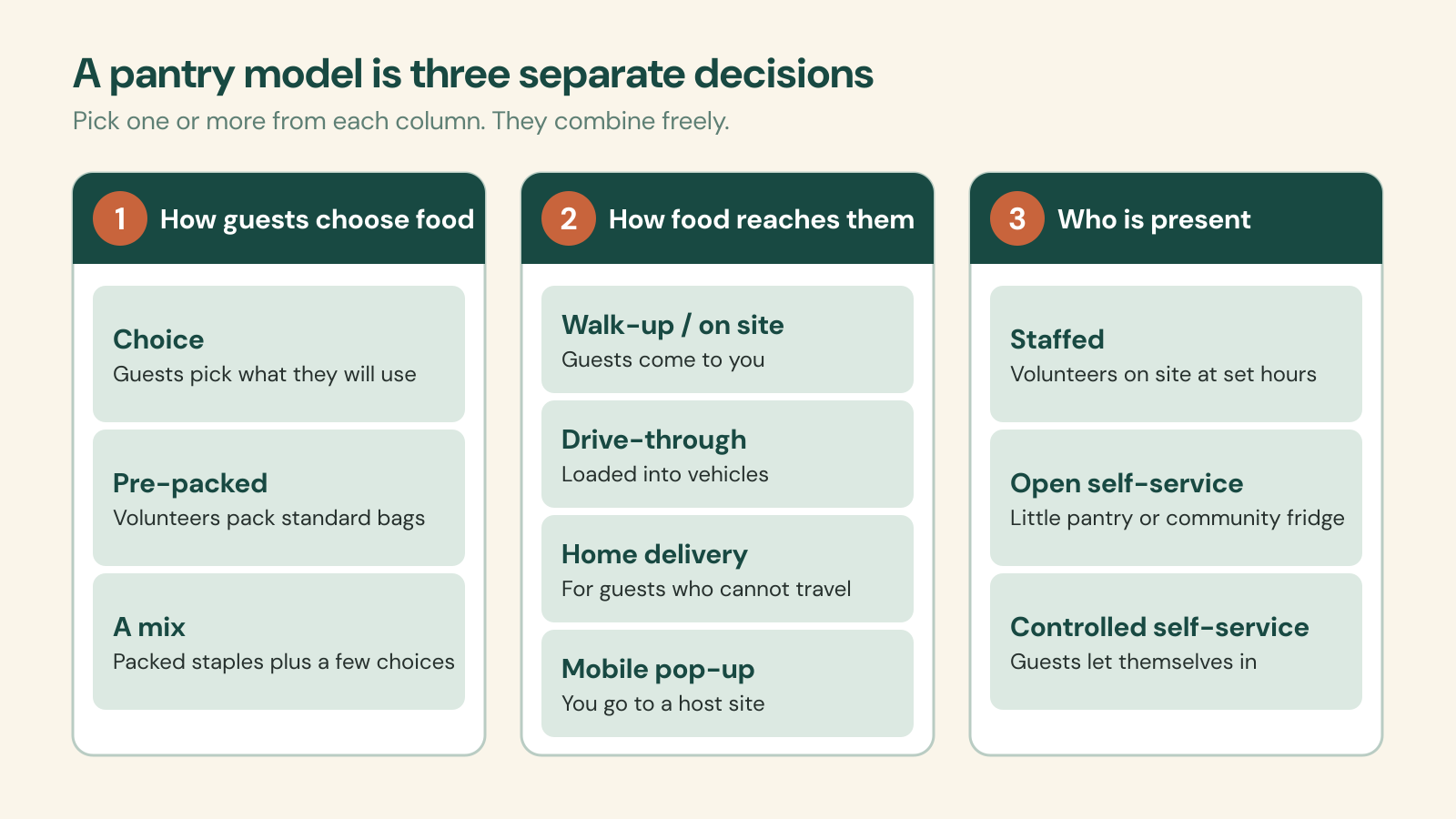
"Pantry model" bundles three different decisions: how guests select food, how food reaches them, and whether a volunteer is present when they get it.
These choices combine freely. A pantry can offer choice shopping without on-site staff, for example, or deliver pre-packed groceries to people at home.
How guests choose food
Choice pantry
Guests select from available items within any published quantity limits. Strengths: matches household preferences and reduces unwanted food. Challenges: needs shelf access, room to move, and a system to replenish stock. Small-space version: a volunteer brings a selection of products to a table, or guests order from a simple paper or online menu.
Pre-packed bags
Volunteers pack standard assortments ahead of time. Strengths: predictable labor and a quick handoff, especially in small rooms. Challenges: less control for guests and more food that goes unused. Improve it with a short preference question, a choice of protein, or a swap table.
How food reaches guests
Walk-up or on site
People arrive on foot, by transit, or by car and receive food at the site. Strengths: no vehicle required, and it is easier to get to know people. Challenges: managing the line, weather protection, and an accessible entrance.
Drive-through
Vehicles move through a controlled loading route. Strengths: serves many households quickly. Challenges: parking, traffic safety, volunteers to load, and no good answer for guests without vehicles unless you add a walk-up lane.
Home delivery
Food travels to guests who cannot reach a pantry. Strengths: serves homebound residents. Challenges: routing, reliable drivers, address privacy, missed deliveries, and keeping cold food cold.
Mobile pop-up
Food is transported to a temporary host site. Strengths: reaches neighborhoods without permanent pantry space. Challenges: vehicle capacity, setup, host permissions, weather, and temperature control.
Appointments and pickup windows
Any on-site model can run on appointments instead of a line. Guests book a time, and you cap how many households come in each window. Strengths: shorter waits, less crowding, steadier work for volunteers. Challenges: guests need a way to book that does not depend on internet access, and you need a plan for walk-ins.
Who is present
Staffed
Volunteers or staff are on site during set hours. This is the most common arrangement and the easiest to supervise. Its limit is the schedule: you are only open when people can work a shift.
Self-service
Self-service means guests can get food without a volunteer on site during the visit. It describes access and staffing, not whether people choose their food. It can be open to everyone or use controlled entry, and it does not by definition require technology, registration, or tracking.
Open-access self-service. A Little Free Pantry or community fridge lets anyone take what they need without an appointment, registration, ID, access code, or recorded visit. It is inexpensive and works in small spaces. Volunteers still need to inspect donations, replenish food, clean the area, keep paths accessible, and remove unsafe items. A community fridge also needs reliable electricity, temperature checks, and a plan for equipment failure.
Controlled-access self-service. Guests shop or collect food independently, but entry is managed through a key, combination, scheduled access, electronic lock, or another method that suits the site. An organization may choose to record visits or limit frequency, but individual tracking is an optional policy decision, not part of the definition. Make access workable for people without smartphones, and plan for lock, power, and connectivity failures.
Self-service tradeoffs
Benefits can include flexible visiting hours, fewer staffed shifts, independent shopping, and better access for guests whose work or transportation schedules conflict with traditional distributions. Tradeoffs include less direct supervision, unpredictable demand, possible loss or misuse of food, and the need for clear signs, good lighting, safe entry and exits, accessible shelving, and an emergency contact.
Set a written schedule for inspecting food, replenishing shelves, cleaning, temperature monitoring where needed, pest prevention, and handling safety concerns. Open-access models may use refill logs and inventory counts instead of household-level visit data. Controlled-access models should collect only the information they need and explain any entry or visit tracking. Post instructions for what to do when the pantry is empty, entry fails, or food appears unsafe.
Redistribution to other agencies
Some organizations do not serve households directly. They receive or rescue food and pass it to partner pantries and meal programs. Strengths: increases the reach of donated food. Challenges: transportation, traceability, written agreements, and storage capacity. This is rarely the right place to start, but it is worth knowing that the role exists.
Compare the models
Models in this table overlap: "choice" is about selection, "self-service" is about access without on-site staff. The effort a site without staff takes depends heavily on its food, location, and safety needs.
| Model | Guest space | Operational complexity | Small-space fit |
|---|---|---|---|
| Choice pantry | Medium | Medium | Good with a menu or table |
| Pre-packed | Low | Low | Excellent |
| Walk-up | Low to medium | Low to medium | Excellent |
| Drive-through | Outdoor vehicle area | Medium | Depends on parking |
| Home delivery | Very low | High | Good |
| Mobile pop-up | Temporary host site | High | Excellent at home base |
| Open-access self-service | Small shelf or fridge area | Low to medium; frequent checks | Excellent with a safe location |
| Controlled-access self-service | Small guest area | Medium; entry and upkeep | Good with a suitable layout |
| Agency redistribution | Storage and dispatch | High | Limited without logistics |
Discuss with your team
- Can guests choose at least some items?
- Where will guests wait during rain or extreme heat?
- If no one staffs the site, who inspects the food, stocks shelves, and responds to access problems?